Showing posts with label Story. Show all posts

Misty of Chincoteague

Misty of Chincoteague: When a Pony Became a Promise Between Humans and Nature

On a quiet island off the coast of Virginia, where salt marshes breathe with the tide and wind carries the cries of seabirds, a small pony once carried a very large meaning. Misty of Chincoteague is often remembered as a children’s horse story—but its true power lies in how gently it teaches responsibility, restraint, and reverence for the natural world.

At its heart, Misty of Chincoteague is not about ownership. It is about relationship.


An Island Shaped by Water—and Wisdom

Chincoteague Island exists in a delicate balance with the sea. Storms shape its shores, tides dictate daily life, and the famous wild ponies live not as pets, but as shared guardians of tradition. Marguerite Henry places her story within this environment intentionally. The island is not a backdrop; it is a living teacher.

The children in the story—Paul and Maureen—grow up understanding that love does not always mean possession. Their longing for Misty is deep and sincere, but it is constantly tested against the needs of the pony, the herd, and the island itself. This tension becomes the moral core of the narrative.


A Chincoteague mare and her foal run along the shoreline, capturing freedom, care, and the quiet rhythm of island life.


Misty as a Symbol, Not a Trophy

Misty herself is more than a rare pony. She represents something fleeting and sacred: the moment when humans encounter wild beauty and must decide how to respond.

Will they dominate it?
Or will they protect it—even if that means letting go?

Misty’s journey reminds readers that care is proven through action, not desire. The pony’s safety, her bond with her foal, and her place within the larger ecosystem matter more than the children’s dreams. In this way, Misty of Chincoteague quietly teaches environmental ethics long before conservation became a mainstream conversation.


The Pony Penning: Community Over Individual Want

One of the most striking elements of the story is the Pony Penning tradition—a real annual event where the islanders round up the ponies to manage herd size and fund fire services. Henry presents this not as spectacle, but as collective responsibility.

The ponies are not owned by one person.
They are cared for by many.

This idea—shared stewardship rather than private control—is rare in modern storytelling, especially in animal narratives. It challenges the reader to think beyond “mine” and toward “ours.”


Why the Story Still Matters

Decades after its publication, Misty of Chincoteague continues to resonate because its message feels increasingly urgent. In a world where nature is often commodified, photographed, captured, and consumed, Misty’s story offers a softer, wiser path.

It asks:

  • Can we love without taking?

  • Can we protect what we admire?

  • Can children be trusted with big moral truths?

The answer, gently but firmly, is yes.


A Legacy Hoofprint

Misty of Chincoteague helped transform a local island tradition into a global symbol of humane conservation. It inspired generations of young readers to care about horses, islands, and the fragile agreements between humans and the wild.

Misty did not just become famous.
She became a reminder.

Some stories don’t gallop.
They walk beside us—steady, quiet, and enduring—like a small pony leaving hoofprints in wet sand, trusting us to notice where we step next.


The Malamute and the Mustang

🌨️πŸ• The Malamute and the Mustang: A Mythic Folktale of Frost, Fire, and the Meeting of Two American Spirit Guardians πŸŒΎπŸ΄


Imagine a twilight plain where the snowy winds of Alaska meet the dry winds of the American West. The air itself seems to hold its breath, caught between two worlds—one carved by ice and silence, the other by sun and endless motion.

From the northern edge comes the Alaskan Malamute spirit, ancient as the tundra, his fur heavy with the memory of snow and frost. Each step he takes leaves a shimmer of crystalline breath in the air, and his eyes glimmer with the wisdom of countless winters. Behind him stretch the whispers of sled trails and the soft glow of constellations that have guided wanderers through polar nights.

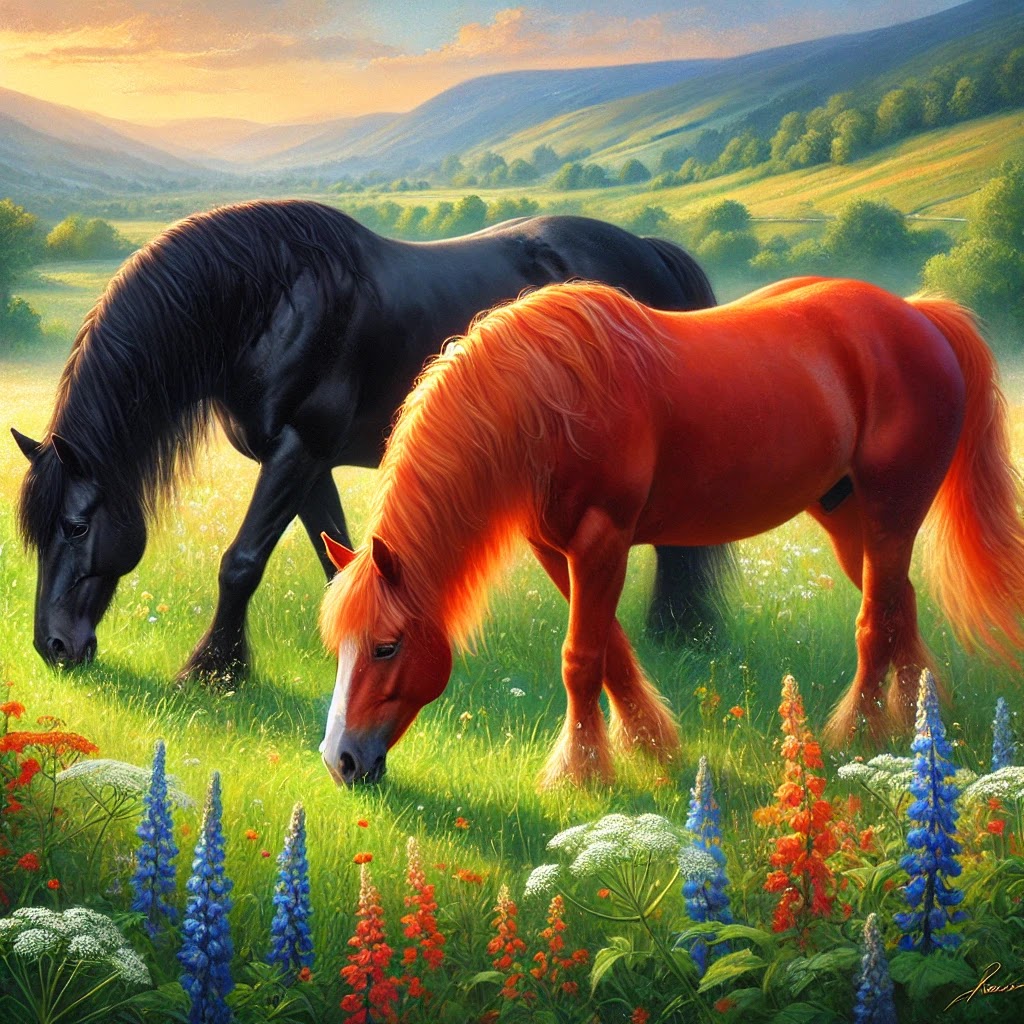
From the western horizon comes the Mustang spirit, a young stallion forged in dust and fire. His mane is a wild banner of red-gold, tangled with the winds of the open plains. His hooves strike the earth with the rhythm of freedom, echoing the thunder of wild herds that once roamed unbroken. Behind him rise the silhouettes of golden grasses and the long shadows of riders chasing the horizon.

As they draw near, the plain becomes a threshold. Snow and dust twirl together in the twilight, painting the sky in hues of violet and ember. Here, the elder of the North and the youth of the West meet—not as rivals, but as guardians of different truths. One carries endurance, patience, and memory. The other carries fire, speed, and the hunger for unclaimed space.

In their meeting, the land itself seems to hush, waiting to hear what will be spoken—what wisdom will be shared when frost and flame cross paths.


Malamute:
“I have walked this land for thousands of winters. My paws pressed the snow before the settlers’ boots touched these shores. My people, the Mahlemut, shaped me to endure, to carry, to survive. I am of the Arctic, where silence is life and endurance is glory.”

Mustang (snorting, tossing his mane):
“And I gallop where the sun burns the plains. I was not born here as you were, elder, but I became the heartbeat of this frontier. With the cowboys and the dreamers, I raced across the wild. They called me freedom—untamed, unstoppable.”

Malamute (with a deep rumble of patience):
“Freedom, yes… but younger brother, do not forget: I was freedom in the ice long before you. I hauled hunters through blizzards, guided families through the white silence. My strength was quiet, unseen. Yours—shouted in the songs of men.”

Mustang (stamping proudly):
“And yet it is I they painted in murals, I they sang about in dusty ballads. They crowned me symbol of America. While you… they left you to the cold margins, though your roots run deeper than mine.”

Malamute (eyes glowing like northern stars):
“Symbols are not always truth, Mustang. You carry their myths, but I carry their beginnings. You burn bright like fire; I endure like stone. Together, we are two faces of this land: your spirit—the dream of freedom. Mine—the memory of survival.”

Mustang (softening, lowering his head):
“Then perhaps we are not rivals, but companions. The West needed my gallop; the North needed your pull. The land remembers us both.”

Malamute (with a slow, knowing wag of his tail):
“Yes, young stallion. The land remembers.”


The wind carries both their voices—dust and snow blending into one horizon, as if the land itself remembers their meeting. For a moment, time holds still, the twilight sky painted with the breath of two worlds.

The Mustang rears and gallops back into the golden plains, hooves striking sparks of freedom, his mane flashing like sunset fire across the open expanse. He is the heartbeat of restless horizons, the spirit of motion and unclaimed dreams.

The Malamute turns toward the North, his paws sinking into ancient snow, each step a quiet echo of endurance and memory. His breath rises into the night like smoke, carrying the wisdom of stars and the patience of frozen earth.

They part as they came—two guardians walking opposite paths, yet bound by the same soil. One carries the fire of the West, the other the frost of the North. Together, they shape the land not by conquest, but by balance.

Different paths, same earth. Different voices, one song. And long after their figures fade into snow and dust, the horizon remembers—the meeting of frost and flame at twilight.


Reflective Message

Stories like these are more than myths; they are mirrors. The Malamute and the Mustang remind us that the world is held together not only by sameness, but by the meeting of opposites. Endurance and freedom. Patience and fire. Memory and motion.

We, too, carry both within us. Some days, we walk with the Malamute—steady, grounded, enduring what is long and cold. Other days, we run with the Mustang—wild, daring, chasing horizons no one else can see. Both are sacred. Both are needed.

The earth does not choose between snow and dust, twilight and fire. It carries them together, letting them meet, mix, and shape its beauty. In the same way, our lives are formed not by choosing only one path, but by learning to honor the many spirits within us.

So when the winds rise—whether frosted or burning—may we remember: different paths, same earth. Different voices, one song. And may we listen for that song in ourselves, and in each other.


The Eternal Spirit of the Arabian Horse

The Eternal Spirit of the Arabian Horse: A Legend Born of Desert Winds and Timeless Bonds

Long before the rise of empires and the spread of civilizations, before the vast deserts of the Arabian Peninsula gave birth to countless legends, there existed a breed of horse unlike any other. This horse was born in the heart of the desert, a creature of unmatched beauty, strength, and endurance. Its curved profile, large, expressive eyes, and arched neck made it seem as if it had been sculpted by the hand of a divine artisan. It was said that the Arabian horse, known to some as the Ayyad, was the oldest breed in the world—a living symbol of grace and power. Some claimed it was a gift from the gods themselves, a steed crafted from the desert winds, the glow of the moonlight, and the fire of the sun’s first dawn. Others whispered that it was born from the breath of the north wind, swift as a sandstorm and gentle as an evening breeze.

Legends tell of how the first Arabian horse emerged from the mists of time to stand at the side of the Bedouins, not as a mere beast of burden but as a sacred companion. Warriors swore oaths upon its back, poets wove verses about its nobility, and tribal leaders viewed it as a sign of prestige and divine favor. The Arabian horse was no ordinary creature—it was a partner in survival, a trusted ally in battle, and a cherished member of the family. It shared tents with its masters, guarded them during the night, and carried them to victory during the day.

Its lineage would forever be entwined with the soul of the desert, as eternal as the shifting sands. The harsh desert sun could not break its spirit, nor could the cold of night dim its fire. Its endurance became legend. When others faltered, the Arabian horse pressed on, swift and tireless, carrying messages across the wasteland and leading warriors into battle. Tribes believed that their fortunes were tied to the fate of their horses, and bloodlines were guarded with a reverence equal to that of royalty. Each horse carried with it the pride, honor, and survival of its people.

But beyond its utility, the Arabian horse held a spiritual presence. Poets called it the "Desert's Shadow," a living echo of the wild, untamable beauty of nature. To own such a horse was to hold a piece of the desert's heart. To ride one was to feel the pulse of the ancient world, as if galloping alongside the great heroes of old. It was not simply a breed of horse—it was a legacy, a symbol of freedom, and a bridge between the mortal world and the realm of legend.

Even today, the blood of those ancient steeds flows in the veins of Arabian horses across the world. Their influence can be seen in the grace of thoroughbreds, the power of warmbloods, and the elegance of dressage champions. But no other horse carries with it the same spirit of the desert—the fierce independence, the quiet nobility, and the unbreakable bond with humanity. To this day, when the silhouette of an Arabian horse is seen against the horizon, it stirs something ancient in the heart of those who gaze upon it—a reminder of an ageless partnership born from the sands of time.


The Dawn of the Ayyad

The sun had not yet risen over the vast Arabian desert, but the wind was already stirring, whispering through the dunes like a forgotten song. In the shadow of the great mountain Al-Qamar, where the sky met the earth in a perfect horizon, a tribe of nomadic Bedouins gathered around their fire. The elders spoke of a time long past, when the desert was young and the first of the Arabian horses were born.

It was said that in the age when the stars were still forming, the moon goddess, Lailah, descended from the heavens. She wandered the earth, searching for a creature that could embody the spirit of the desert—unfathomable, yet beautiful; fierce, yet gentle; free as the wind, yet noble as the sun. She found her answer in a foal born under the light of a full moon, its coat shimmering like silver in the twilight. This foal, with its dark eyes and graceful limbs, was unlike any creature that had ever walked the earth.

Lailah whispered a blessing over the foal, and with it, she bestowed a gift that would forever change the course of history. The foal was to be the first Ayyad, the first of the Arabian horses. The goddess, knowing that this breed would carry the legacy of the desert’s soul, named the horse Zahrat, meaning “flower,” for it bloomed like the first flower in a desert rainstorm.

The Bedouins believed that the Ayyad was touched by the divine and that its spirit was as eternal as the desert itself. As the centuries passed, the Arabian horses roamed the sands, their hooves leaving imprints on the earth that would never fade. They were bred for speed, endurance, and loyalty—qualities that mirrored the unyielding nature of the desert.


The Bond Between Horse and Rider

As the centuries passed, the Arabian horse became more than just a companion to the Bedouins. It became a symbol of life itself, a bridge between man and the elements. The relationship between the horses and their riders was sacred. Each Bedouin tribe had its own horses, and the bond between the rider and the horse was one of deep respect and mutual understanding.

The Ayyad horses were used for travel, war, and trade, but it was in times of peace that their true nature shone. They were swift and surefooted, able to navigate the harsh desert terrain with ease. A skilled rider could traverse the longest stretches of sand, knowing that their horse would guide them to safety, no matter how unforgiving the desert became.

One such rider was Rashid al-Din, a young man born to a legendary Bedouin family. Rashid’s father was known throughout the desert for his unmatched skill in horsemanship, and he had raised his son to be a master rider. The boy’s horse was a stallion named Thamar, a descendant of Zahrat, whose bloodline was said to run through the veins of every Arabian horse.

Thamar was a stallion with a coat as white as the moon and eyes that seemed to gleam with wisdom. He and Rashid shared a bond that was as old as time itself. Rashid trusted his horse as if it were his own soul, and in turn, Thamar trusted Rashid with a loyalty that could never be broken.

One fateful day, a rival tribe threatened the peaceful lives of Rashid’s people. They planned to attack the nomads under the cover of night, but the Bedouins had learned long ago that the desert could speak to those who knew how to listen. Rashid and Thamar rode out into the darkness, following the whispers of the desert wind.

As the enemy closed in, Rashid felt the stir of Thamar’s hooves beneath him—steady and sure. The stallion’s powerful muscles rippled as they galloped across the sand, faster than the wind itself. The sound of their hooves was like thunder, echoing through the empty desert.

The rival tribe, hearing the approach, turned to see Thamar leading Rashid into battle, his silver coat glowing under the light of the moon. The enemy hesitated, knowing that they were about to face a force as ancient and eternal as the desert itself. In the heat of the conflict, Rashid and Thamar fought together as one, the horse’s swiftness and strength guiding his rider through every clash. It is said that the enemy was overwhelmed by the power of the Ayyad—a horse born of the gods—and that they fled in fear.


The Spread of the Arabian Horse

As the centuries passed, the legend of the Ayyad spread far beyond the Arabian Peninsula. The power and grace of these horses captivated the rulers of distant lands. From the fertile crescent to the grand cities of Persia and Egypt, the Arabian horse was sought after by kings and queens, warriors and poets. Its unmatched speed, endurance, and beauty made it a symbol of royalty and prestige.

The Ayyad horses were brought to Europe, where they were bred with local horses to create a new generation of steeds—stronger, faster, and more versatile. The Arabian horse’s influence spread through the breeding of the Andalusian, the Lipizzaner, and countless other legendary breeds.

But despite their growing fame, the true spirit of the Ayyad remained tied to the desert. The Bedouins continued to care for and preserve the ancient bloodline, guarding their horses as treasures. The desert was their home, and the horses were their life.


The Eternal Horse

In the modern world, the Arabian horse still carries the same grace, strength, and power it has held for millennia. It is a symbol not only of the desert but of the unbreakable bond between humanity and the creatures that have helped shape the course of history. The legacy of the Ayyad lives on, in every Arabian horse that gallops across the fields, in every race won, in every heart that beats with the rhythm of the hooves.

It is said that when you look into the eyes of an Arabian horse, you see the spirit of the desert—the wind, the sand, and the stars. And in that gaze, you can sense the ancient power of the Ayyad, the first horse, born under the light of the moon, forever entwined with the soul of the earth.

The Ayyad is not just a horse—it is the eternal spirit of the desert, the keeper of ancient wisdom, and the living link between the past and the present. And as long as the horses of the Arabian breed run across the earth, their legacy will live on, carried by the wind, forever free.


Moral Message: Respect, Legacy, and the Bond Between Beings

The story of the Arabian horse teaches us the value of respect for nature and living beings. Bred in the harsh deserts, these horses thrived not through dominance but through a deep, mutual trust with their human companions. Their loyalty was not demanded but earned. This reflects how kindness, patience, and respect can nurture powerful and lasting bonds.

Another key moral is the importance of preserving heritage and legacy. Just as the Arabian horse's lineage has endured for millennia, so too should we honor and protect the cultural and natural legacies that have been passed down to us. The horse symbolizes both the strength of tradition and the beauty of adaptability.

Lastly, the story reminds us that true strength lies in both heart and spirit. The Arabian horse was valued not just for its speed and endurance but for its intelligence, loyalty, and unwavering spirit — qualities that humanity can aspire to in its own journey through life.


Ginger’s Tale

Ginger’s Tale: A Life of Fire and Fury

Introduction to Ginger

In Black Beauty, Ginger is often seen as a foil to Black Beauty, a strong-willed mare with a history of hardship. Unlike Beauty, who comes from a place of quiet dignity and gentleness, Ginger’s life is shaped by rebellion and fiery defiance. Her story begins in the shadow of cruelty, and her struggles with authority are profound. She is a mare who, at her core, refuses to be broken by the hands that seek to control her, yet her rebellion is not one of mere anger—rather, it is a deep, unyielding desire for freedom.

Ginger’s early experiences paint a grim picture of life for a horse in the hands of cruel owners. She is passed from one human to the next, each new master failing to understand her spirit and instead seeing her as a challenge to be tamed. In her heart, Ginger harbors a deep mistrust for humans, believing that kindness and compassion are foreign concepts. She finds herself in stark contrast with Black Beauty, who, despite his suffering, maintains a calm, trusting nature. Where Black Beauty seeks comfort in loyalty, Ginger seeks escape.

This is her story—of survival, defiance, and the longing for a life beyond the reins.


I wasn’t born to endure the bit, the rein, or the whip. I came into the world with a fire in my chest, a blaze that no human hand could tame. My mother told me once, when I was still a foal, that life would be what I made of it. "Be strong, little one," she said. But no one prepared me for the strength it would take to survive the hands of men.

I remember my first master, a man with a silver tongue and a heart of iron. He was the one who named me Ginger, for the streaks of red in my coat. At first, I thought the name was beautiful, like the setting sun. But it became a badge of their ownership, a reminder that they saw me not as a being, but as a tool—a commodity to be polished and paraded.

The bearing rein was the first betrayal. They forced my head high, straining my neck until it felt as if the very sky would break me in two. The pain was constant, but worse was the humiliation. They loved the look of me, they said, a picture of elegance. But they didn’t see the anguish behind my eyes, the defiance simmering beneath my polished exterior.

I fought back when I could. Bucked, reared, bit at hands that sought to control me. But resistance came at a cost. They called me wild, unmanageable, and I was passed from owner to owner like a cursed coin. Each hand was a new lesson in cruelty or indifference, and each lesson chipped away at that fire in my chest.


Then I met Black Beauty. He was different—a steady soul, calm and wise, with an understanding that seemed to transcend the turmoil of the world around him. His presence was like a quiet refuge, a balm to my seething rage, though I knew he couldn’t fully understand the depth of my fury. He hadn’t lived through the things I had—the unrelenting parade of indignities and punishments that had shaped my every step, the harsh hands of those who had sought to break me. But there was something in his gentle eyes that made me feel as though, for the first time, I wasn’t alone.

As I stood there, my heart still burning with anger, I couldn’t help but ask him, “How do you stay so calm, so... at peace with everything?”

Black Beauty turned his head slowly, his eyes soft and thoughtful. “It isn’t about being at peace with everything. It’s about finding stillness inside yourself, no matter the storm outside,” he said, his voice gentle, like a soft breeze.

I snorted, tossing my head. “That’s easy for you to say, isn’t it? You’ve never been punished without reason, driven to the edge by cruelty...”

He took a step closer, his hooves barely making a sound on the ground, and nudged me gently with his muzzle. “I’ve known hardship too, Ginger. I’ve felt the sting of a cruel hand, the weight of expectations I couldn’t always meet. But I learned that holding onto anger only ties you to the pain. It doesn’t make it go away.”

I shook my head, trying to ignore the ache in my chest. “I don’t know how to let it go. It’s too much... too deep. You wouldn’t understand.”

“I may not know everything about your journey,” Black Beauty replied, his voice soft and understanding, “but I do know that anger, as strong as it is, can never heal a wounded soul. Letting it go might be the first step toward finding the peace you long for.”

I stood silent for a moment, gazing out at the meadow before us, the sunlight streaming through the trees. “I don’t know if I can. It feels like too much of who I am...”

Black Beauty took a step back, giving me space to think, yet his presence remained like an anchor. “You don’t have to do it alone. We all have our burdens, but sharing them, even in silence, can ease their weight.”

His words, so simple yet so profound, lingered in the air between us. And in that moment, I felt a flicker of something I hadn’t allowed myself to feel in a long time—hope.

Maybe, just maybe, I could find a way to heal. And maybe, just maybe, it would start with learning to trust again.


Even in the hardest moments, I envied his calm, his quiet resolve. Where I burned with anger and frustration, he stood firm, unmoving, like a mountain weathering a storm. Where I fought, resisted, and struggled against the chains of injustice, he endured, his spirit unbroken, though I could see the flicker of sadness in his eyes. It was a sadness I knew all too well—though it was never as sharp or as raw as mine. His suffering had been tempered by time, by wisdom, while mine was still fresh, like an open wound.

I watched him one day, as he calmly grazed, his head low, his movements slow and deliberate. I couldn’t understand how he could be so composed, so accepting of everything that had been dealt to him. I couldn’t grasp how he found peace in the midst of a world that seemed so bent on breaking us.

“Don’t you ever get angry?” I asked him one afternoon, my voice sharp with frustration.

Black Beauty paused in his grazing and looked up at me, his eyes soft yet knowing. “Anger is a heavy thing to carry,” he replied, his tone measured, yet carrying the weight of years. “It’s like a flame that consumes everything in its path, including the one who holds it.”

I felt a twinge of resentment at his words, my insides burning at the thought of giving up my anger. “But if I don’t fight, if I don’t resist, what am I left with? What’s the point of all this suffering if we just lie down and take it?”

He stepped closer, his large, dark eyes full of understanding. “I don’t lie down and take it. I stand firm, not out of submission, but because I choose to endure. There’s strength in patience, Ginger, a strength that rebellion doesn’t always see.”

I felt a surge of bitterness rise in me. “You make it sound so simple,” I snapped, tossing my head. “But it’s not! You don’t know what it’s like to have everything stripped from you, to feel like there’s no hope left. To be left with nothing but anger and pain.”

Black Beauty stood quietly for a moment, his gaze never leaving me. “I know more than you think. I too have been stripped of things—my freedom, my dignity. I’ve felt the sting of a cruel hand and the weight of expectations I couldn’t meet. But I learned that while anger burns, it also blinds. Patience, on the other hand, lets us see things clearly, even in the darkest of times.”

I looked away, feeling a mix of confusion and frustration. “I’m not like you. I can’t be calm. I can’t just wait for things to get better. I need to fight. It’s the only way I know how to survive.”

Black Beauty sighed softly, his voice gentle yet firm. “You’re right, Ginger. You don’t have to be like me. We each carry our burdens in our own way. I choose patience because I’ve learned that it allows me to keep moving forward, even in silence. You choose rebellion because it’s the way you know to survive. But in the end, we both carry the weight of humanity’s whims. And whether we fight or we endure, it’s a burden we share.”

I was silent for a long time, the weight of his words sinking in. It wasn’t until much later, as I watched him again, his quiet strength a stark contrast to my own restless energy, that I realized he wasn’t asking me to be like him. He wasn’t asking me to abandon my spirit of rebellion. He was simply reminding me that there was more than one way to face the storm.

Where I fought, he endured. And in some strange way, that made me feel less alone.

My story doesn’t end like Beauty’s, with the peace of a green pasture and a kind hand. My legs grew weaker with each passing day, my spirit dimmed as the years wore on, and I was sold off to men who cared little for life, mine or theirs. The flicker of hope that had once burned brightly in me began to sputter and fade, smothered by harsh hands and cruel demands. They didn’t see the fire in my heart, nor the scars beneath my skin, worn not just from their whips but from the years of longing for a life I was never allowed to have.

The men who took me in were callous, treating me as nothing more than a tool to be used and discarded. They pushed me to my limits, working me beyond exhaustion, until the spark that once made me fight now seemed a distant memory. But even in my fading strength, there was something that would not break. The fire in my chest, that fierce, untamed flame, never fully went out. It burned for the freedom I never knew, for the life I could have lived in peace, for every horse still bound by bit and rein, forced to endure the cruelty of a world that only saw us for our labor.

If nothing else, let my story serve as a warning. Kindness matters, more than humans realize. It matters to the horses who feel the sting of the whip, the harsh tug of the rein, the ache of their bodies worn down to nothing. But it matters more to those who don’t just endure, but who could have thrived—who could have been more than just servants to humankind. Horses like me, who have a spirit, a soul that aches for something more than the life we’ve been given.

To those who read these words, remember: we horses are not machines, not objects to be used until we can no longer serve. We are creatures of feeling, of connection, and of untold strength. We feel the whip, the rein, the pain—but we also feel love, friendship, and hope. It is not the hands that break us that are remembered in the end, but the hearts that showed us kindness, that cared for us with tenderness and respect. We long for those moments, those glimpses of a life that is kind, that treats us as equals, as beings worthy of compassion and grace.

In the end, my fire was never meant to be doused. It was meant to light the way. To guide those who would listen toward a future where no horse ever again had to endure what I did. I may have faded, but my spirit—my spirit remains. Let it burn brightly in the hearts of those who care, and may it ignite a change in the hearts of those who still do not see us for what we truly are. We are not simply creatures to be ridden or raced. We are beings who feel, who dream, who deserve to live freely and without fear. Let my story be the spark. Let it light the way toward a future where kindness reigns, and where no horse has to fight for the right to live.


Moral Message:

The moral message of this story is a powerful reminder of the importance of kindness, empathy, and respect toward all living beings, especially animals. It emphasizes that horses, like humans, are not mere tools or commodities, but creatures with their own emotions, desires, and rights. The story calls for a deeper understanding of their suffering and the need to treat them with compassion and dignity.

The tale of Ginger, though marked by hardship and rebellion, teaches that even in the face of cruelty and oppression, the spirit can endure. It highlights the significance of kindness in shaping the world we live in, urging readers to reconsider how they treat animals and to recognize that every act of compassion can help bring about a positive change.

Ultimately, the moral encourages us to reflect on how we treat others—whether human or animal—and reminds us that kindness, no matter how small, has the power to light the way toward a more just and compassionate world.